
“We would like to express our gratitude to you (Hunt Willis) for accepting our case. First of all, when I called this law firm, a very sweet and kind lady answered the telephone and gave me assurance by asking and going over the accident with me, while my husband was in the hospital. I felt assured I was doing the right thing for us. She was so helpful in so many ways. What a professional lady. Secondly, we are much pleased that you have settled this case with the insurance company to receive the proper amount to assist us in so many ways. My husband and I are very happy with you and the firm in handling our case. You made us have confidence in your professional and integrity along with your assistant Ms. Routh, when you both came to see us in our home, in which we saw your compassion and thoughtfulness at that time. We will never forget what you have done for us, and we thank the lord for directing me to contact this firm. I’m glad I did.”
Baby Powder Inhalation and Mesothelioma North Carolina Lawyers
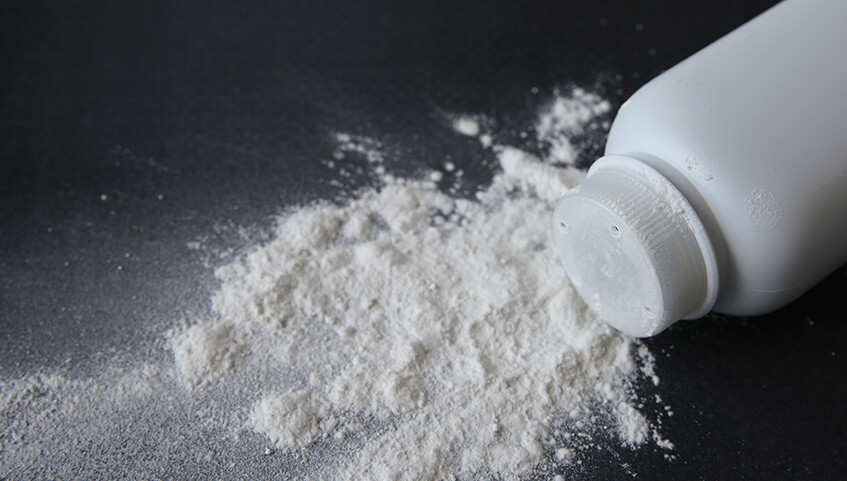
Johnson & Johnson is under legal scrutiny due to a discovered connection between baby powder and deadly cancers. For more than a century, Johnson & Johnson incorporated talc in its baby powder, cosmetics and personal care products. Recent lawsuits and studies have linked Johnson & Johnson baby powder to asbestos contamination.
Asbestos is a silicate mineral that when inhaled is hazardous to humans. Exposure to asbestos increases the risk of developing certain cancers, including malignant mesothelioma. The accidental inhalation of contaminated baby powder can also cause asbestos-related cancers.
Mesothelioma Litigation
Johnson & Johnson baby powder users diagnosed with mesothelioma have been bringing their grievances to court. A Los Angeles jury awarded $21.7 million in damages to 68-year-old Joanne Anderson. She used Johnson & Johnson baby powder for decades before developing mesothelioma. Anderson testified that her use of the product caused her to inhale talc, and thus asbestos. Johnson & Johnson denied liability.
A New Jersey jury awarded Stephen Lanzo compensatory damages of $37 million and $80 million in punitive damages. Like Anderson, Lanzo used baby powder for more than 30 years. Plaintiffs attorneys presented evidence showing cross-contamination of talc with asbestos.
Questions about Baby Powder Inhalation and Mesothelioma
Contact Us for AnswersAsbestos Contamination Studies
Independent studies have shown that asbestos contamination is still commonplace in consumer-grade talc powder, despite current Food and Drug Administration regulations and corporate claims. Recently, Robert Cameron, M.D. led a series of tests on eleven different samples of cosmetic talc powder. Of those, eight were found to have contained tremolite, a type of asbestos.
Johnson & Johnson Documents
Internal documents from Johnson & Johnson have been used against the company. One 1973 document reports that talc from a Johnson & Johnson mine “contains talc fragments classifiable as [asbestos] fiber.” In the same year, a Johnson & Johnson executive performed calculations to determine what the asbestos contamination level would be for a baby. These documents suggest that the company was aware of asbestos contamination issues. A May 1974 memo pushed to repress distribution of a pamphlet warning against asbestos contamination of talc. A stark contrast exists between these documents and Johnson & Johnson’s public statement issued at the time. “Johnson & Johnson takes great care to assure the quality of its products… Over fifty years of research and knowledge in this area indicates that there is no asbestos contained in the powder,” the company assured.
Need A Personal Injury Lawyer?
Helping injured people is what we do. Contact us today for a free consultation to find out how we can help you.